

Component Compass
Component Compass Timeline
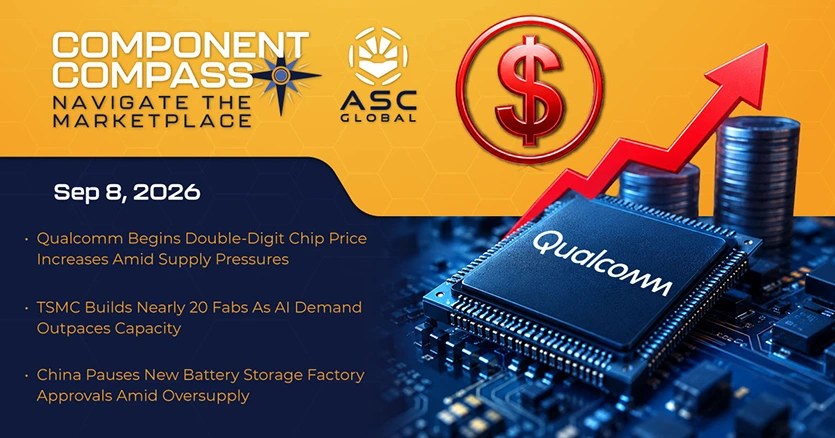
Qualcomm Chip Price Increases Supply Pressures
Qualcomm price increases and TSMC fab expansion to AI memory, battery storage, and GaN/SiC power innovations.
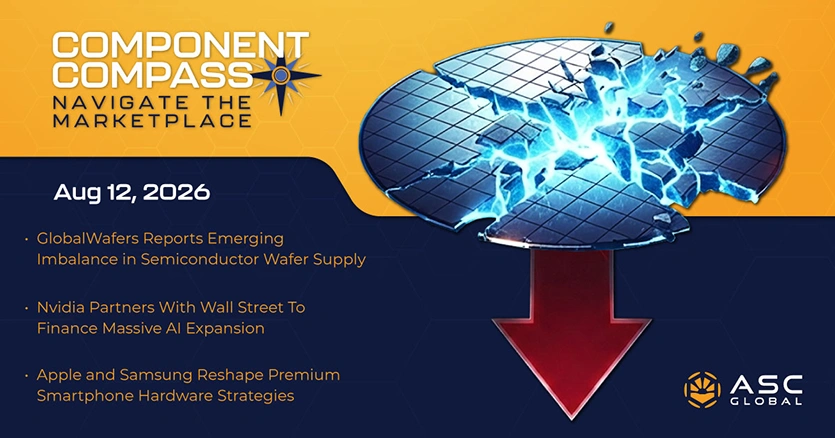
GlobalWafers Semiconductor Wafer Supply Imbalance
GlobalWafer’s semiconductor wafer supply imbalances, NVIDIA’s AI expansion, Apple and Samsung’s evolving premium hardware strategies.
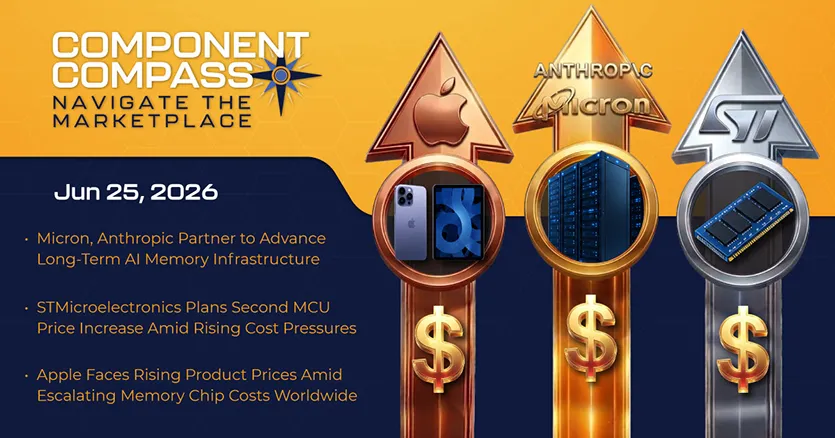
STMicroelectronics MCU Price Hikes, Apple Device Inflation, and Micron–Anthropic AI Memory Supply Shift
STM MCU prices rise on AI demand and costs; Apple hikes prices on memory inflation; Micron-Anthropic shift memory to AI infrastructure.
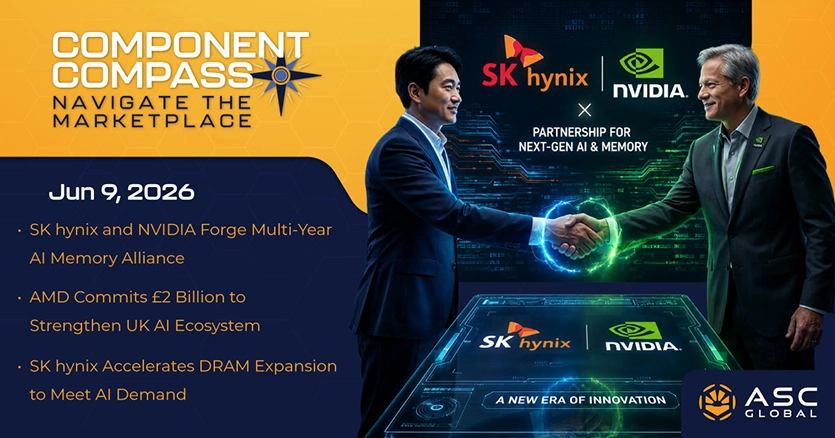
SK hynix and NVIDIA Forge AI Memory Alliance
SK hynix and NVIDIA have signed a multi-year technology partnership to develop next-generation memory solutions for AI factories and global data centers.
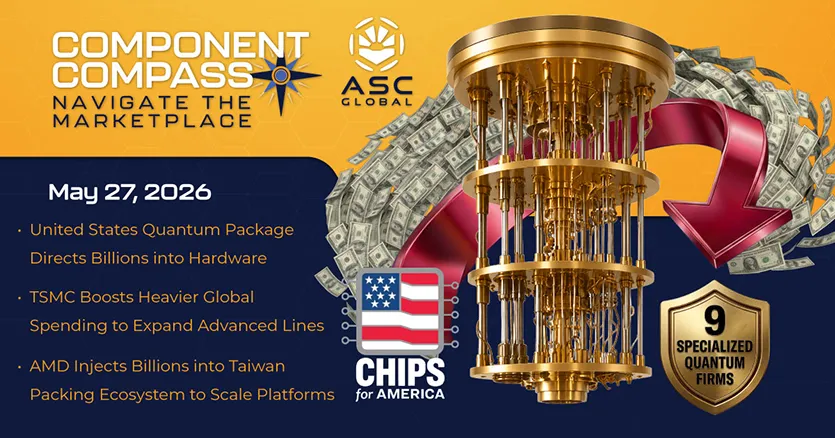
United States Quantum Package Directs Billions
U.S. allocates $2.013 billion in CHIPS Act funding to expand quantum hardware manufacturing and strengthen domestic quantum infrastructure.
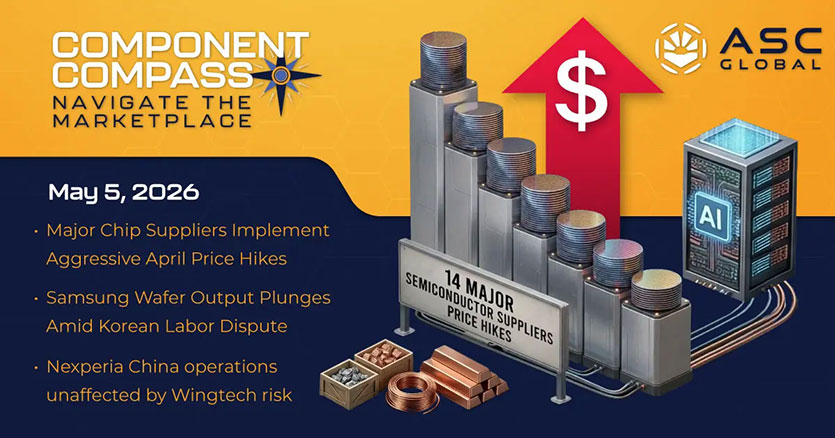
Major Chip Suppliers Implement Aggressive April Price Hikes
Major chip suppliers raise prices by up to 85% as AI demand, raw material costs, and supply constraints reshape the semiconductor market.
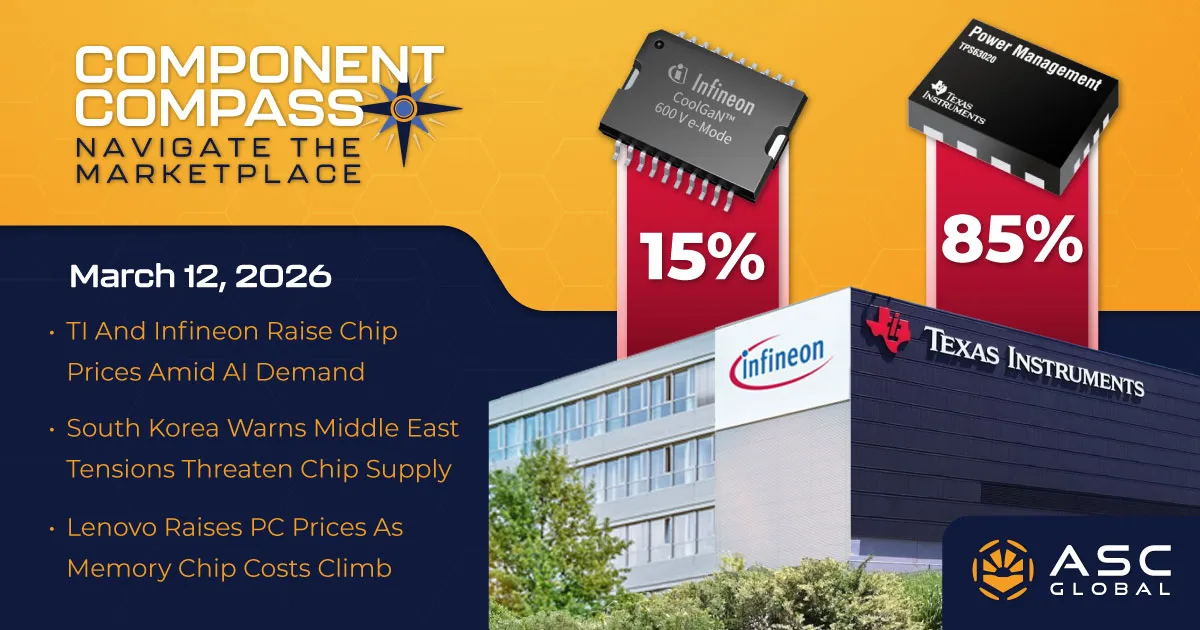
Texas Instruments and Infineon Raise Chip Prices Amid AI Demand
Texas Instruments and Infineon raise chip prices as AI, EV, and industrial demand, plus rising manufacturing costs, reshape the market.
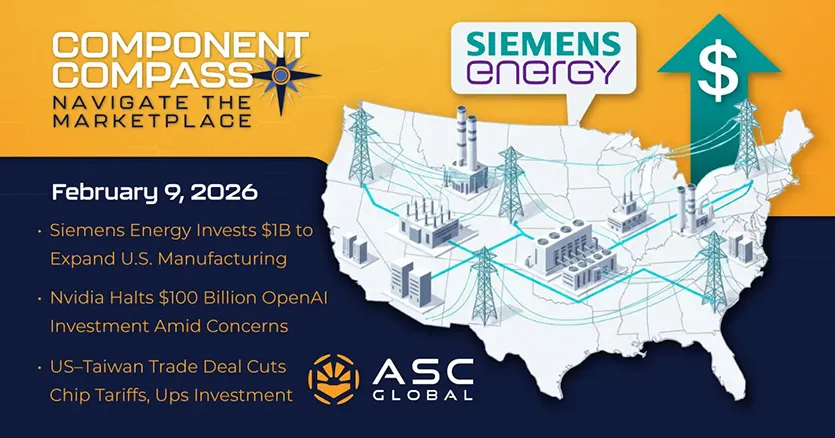
Siemens Energy Invests $1B to Expand U.S. Manufacturing
Siemens Energy invests $1B in U.S. manufacturing to expand grid equipment production and support AI, data centers, and electrification.

Nexperia Conflict Deepens Threatening Chip Stability
Nexperia’s dispute with Wingtech escalates, raising concerns over wafer supply, governance, and semiconductor supply chain stability.
Component Compass
What is the Component Compass, and what does it cover?
The Component Compass is ASC's biweekly industry update, covering significant developments in the semiconductor and electronic components market as they happen. Each issue is written specifically for procurement professionals, supply chain managers, and engineers who need to track how manufacturer announcements, supply disruptions, geopolitical developments, and pricing changes affect component availability and cost.
Unlike general industry news, the Component Compass filters events for their direct relevance to sourcing decisions. Recent updates have covered major chip suppliers implementing price hikes of up to 85% driven by AI demand and raw material costs, labor disputes affecting wafer output at large manufacturers, supply allocation shifts tied to new AI memory partnerships at companies such as Micron and SK hynix, CHIPS Act funding directing investment into quantum and domestic semiconductor manufacturing, and rising PCB prices driven by supply disruption and AI infrastructure demand. Each issue is published biweekly so the information reflects conditions in the current sourcing window, not a summary of the prior quarter.
We manage procurement across several active programs. How does following the Component Compass help us anticipate supply disruptions before they affect our build schedule?
Supply chain disruptions become visible to procurement teams when a supplier raises a price or extends a lead time on a quotation, which is after the underlying market event has already occurred. The Component Compass is designed to surface those events at the point when a sourcing team can still act: before price increases take effect, while inventory at alternative sources is still accessible, and before a supply constraint forces a production line hold.
If a Component Compass update reports that a major NAND Flash manufacturer is reducing wafer output following a labor dispute, or that a key semiconductor supplier is implementing price increases ahead of a specific date, a procurement team managing those device families has time to assess their existing inventory runway, evaluate alternative sources, and submit RFQs while open-market stock is still available. The practical value of the Component Compass is in compressing the time between a market event and a sourcing response.
Our team follows specific manufacturers closely. Does the Component Compass cover manufacturer-level updates, or is it focused on broader market trends?
The Component Compass covers both. Manufacturer-specific updates are a regular element of each issue, including production announcements, pricing changes, supply allocation decisions, quality or production disruptions, and strategic developments at manufacturers including STMicroelectronics, Samsung, SK hynix, Nexperia, Micron, and Siemens Energy, among others. These updates are included when they carry a meaningful implication for component availability or pricing, not as general corporate news.
Broader market trend coverage is also included where it affects sourcing conditions: CHIPS Act funding redirecting domestic manufacturing investment, how AI infrastructure demand is reshaping memory allocation across the industry, and PCB cost trends driven by upstream supply dynamics. Both layers serve procurement teams: manufacturer-level news informs immediate sourcing decisions, and broader trend coverage informs longer-range planning and vendor strategy.
How does the Component Compass differ from ASC's Market Report, and should we be using both?
The two resources serve different planning horizons. The Component Compass is published biweekly and focused on near-term market events: price changes, supply disruptions, manufacturer announcements, and demand signals that affect sourcing decisions within the current planning window. It is the right resource for a procurement team that needs to stay current on conditions affecting active BOMs.
The Market Report is a quarterly deep-dive analysis of broader semiconductor and supply chain trends, covering topics such as the AI-driven memory supercycle, supply chain realignment, pricing forecasts, and lead time outlooks for the coming quarters. It is the right resource for strategic sourcing planning, informing quarterly budgeting, and understanding the structural forces shaping the market over a longer horizon. For a procurement or supply chain team managing both day-to-day sourcing and strategic planning, using both together gives the most complete picture: the Market Report sets the structural context, and the Component Compass tracks how that context is evolving between report cycles.
Is there a cost to access the Component Compass, and how do we receive new issues?
The Component Compass is available at no cost on ASC's website. All published issues are accessible directly on that page in a timeline format, so teams can review both the current issue and prior updates. New issues are published biweekly. If your team relies on the Component Compass as a regular sourcing intelligence input, ASC's website is the primary access point for each new issue as it is released.
Market Report