ASC Hosts Successful Second Year with Embedded World 2023

Mar 18, 2023

ASC, a global provider of electronic components, hosted its second year with Embedded World 2023, and it was a great success! The expo featured over 950 exhibitors from 44 different countries, attracting an incredible 27,000 visitors. This showcase of the latest in technology truly represents the concept of "a smaller world."

Exhibitors from around the world presented their latest advancements in technology. ASC brought revolutionary solutions to common problems, including supply chain shortages and high demand for hard-to-find components.

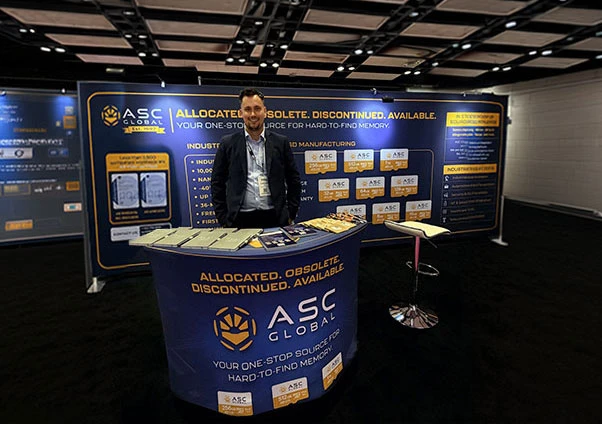
With a 32 square meter space for conversation, interactivity, and lounging, ASC impressed its visitors. We uphold high standards of quality for newcomers and existing clientele. As the official transition to "ASC Global," ASC emphasizes its international outreach with eight offices and growing.

25 Years of Extensive Innovative Solutions

Greeting visitors with smiles of dedication and ambition, ASC provides solutions to common dilemmas immediately. Conversations revolved around guarantee and quality. ASC Global has built a strong reputation with OEM manufacturers and brands backed by 25 years of experience in the electronic distributors market.

Certified in AS 9120:2016, AS 6081:2012, and ISO 9001:2015, ASC never compromises on quality. In-house testing ensures precision. A 24–48-hour global delivery window ensures a seamless experience. From locating to "status: delivered" and a consistent movement in production lines worldwide. ASC firmly believes that "Quality is Non-Negotiable”.

letter box that says Quality is non Negotiable, 8 Offices, US, EU, Mex, Asia

ASC's Embedded World 2023: Successful Outreach Experience

In summary, ASC's second year with Embedded World 2023 was a great success. Showcasing the latest in technology with over 950 exhibitors from 44 countries and attracting an impressive 27,000 visitors. With revolutionary solutions to common problems, and an impression left with a 32 square meter space for conversation, interactivity, and lounging.

Emphasis on international outreach, dedication to quality, and 25 years of experience. That is what makes us a reliable partner for OEM manufacturers and brands worldwide.
 

Frequently Asked Questions About
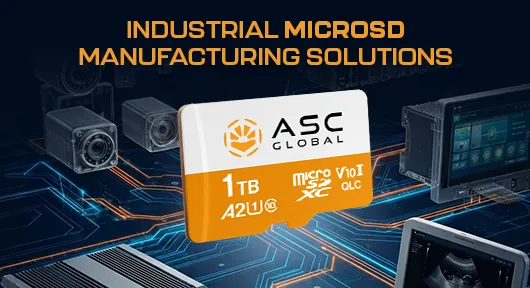
Industrial Microsd

How is ASC's industrial-grade MicroSD different from a standard consumer MicroSD card?

The difference starts at the NAND level. ASC's industrial MicroSD line uses true SLC (Single-Level Cell) architecture on capacities from 4GB to 32GB, which stores one bit per cell and supports millions of write cycles, compared to the multi-bit-per-cell TLC or QLC NAND used in consumer cards, which wear out far sooner under continuous write loads. Higher-capacity cards (64GB to 1TB) use TLC or QLC NAND graded for commercial or industrial duty depending on the application. Beyond the NAND, ASC's industrial cards carry a locked bill of materials, so the controller, firmware, and NAND source stay fixed for the life of the design rather than changing without notice, which is common with consumer-grade cards sold through retail channels. Every industrial card also ships with a 36-month manufacturer warranty and passes 100% pre-shipment quality inspection, neither of which apply to consumer retail products.

Our last microSD supplier changed the NAND or controller without notice and broke our qualification. How does ASC prevent that from happening again?

BOM changes are one of the most common ways embedded and industrial programs lose qualification on a memory component, because a consumer-grade supplier can substitute NAND die, controller firmware, or even the flash vendor between production runs without informing the customer. ASC's industrial MicroSD program locks the BOM at the point of qualification, so the NAND, controller, and firmware combination your engineering team tested and approved is the combination you receive on every reorder for the life of the program. Combined with 100% pre-shipment inspection and a 36-month warranty, this gives procurement and engineering teams a documented, stable part number to build a long-term hardware lifecycle around, rather than requalifying every time a reorder arrives.

We need microSD cards that survive automotive or outdoor temperature swings and years of continuous power cycling. What environmental and endurance specs does ASC's industrial MicroSD line meet?

ASC's industrial MicroSD cards are built for a -40°C to +85°C operating range and a stable 2.7V to 3.6V power profile, which covers the temperature extremes typical of outdoor enclosures, vehicle cabins, and unconditioned industrial spaces. Mechanically, the cards are rated for 10,000 insertion and removal cycles and are tested against ESD, drops, moisture, corrosion, torque, and bending, conditions that a consumer card is never validated against. On the endurance side, the SLC NAND used in the 4GB to 32GB range supports millions of write cycles, which matters for applications like continuous data logging, HMI displays, and always-on surveillance recording where the card is written to constantly rather than occasionally. All cards support the SD 6.1 and UHS-I specifications plus SPI interfaces, with read speeds up to 100MB/s and write speeds up to 80MB/s.

Global memory shortages have made microSD allocation and lead times unpredictable. How does ASC keep supply stable for OEM production schedules?

ASC's industrial MicroSD manufacturing runs independently of the open-market NAND allocation swings that have driven the broader memory shortage, with production capacity of up to 1.5 million units per month and flexible scaling for OEM and high-volume programs. First orders ship in approximately 3 weeks, with faster turnaround on repeat replenishment orders, and customers on ASC's program receive priority allocation during industry-wide shortage periods rather than competing for open-market spot inventory. ASC also supports long-term lifecycle planning mapped to multi-year hardware programs, volume pricing tied to forecast-based manufacturing, and global logistics integration, so a production schedule set 12 to 24 months out can be planned against a defined supply commitment rather than quarter-to-quarter market conditions.

We want a private-label or custom-firmware microSD solution for our product line. What does ASC's manufacturing program support?

ASC's industrial MicroSD manufacturing includes OEM and private-label support, with customizable packaging and firmware tailored to the customer's application, in addition to standard catalog cards. Because production runs through ASC's own manufacturing rather than a repackaged consumer supply chain, customers can work directly with ASC's team on firmware behavior, capacity point, and NAND grade (SLC, TLC, or QLC) before the design is locked, and that configuration becomes the fixed BOM for the life of the program. Free samples are available with full engineering evaluation and compatibility testing before committing to a production order, which lets your team validate the custom configuration against your existing hardware and firmware before volume manufacturing begins.

How does ASC verify quality on every microSD shipment before it reaches our production line?

Every industrial MicroSD order goes through 100% pre-shipment quality inspection before it leaves ASC's manufacturing facility, backed by a 36-month manufacturer warranty on the finished product. This sits alongside ASC's broader quality infrastructure across its component lines, including AS 6081:2012 certification for counterfeit avoidance, ISO 9001:2015 and AS 9120:2016 certifications supporting traceability for regulated industries, and an in-house testing lab capable of XRF analysis and electrical testing to confirm that a card's marked capacity, NAND grade, and temperature rating match what actually ships. For programs that need documentation beyond standard inspection, including automotive, medical, or aerospace end uses, ASC can provide certificates of conformance and traceability records covering the manufacturing lot.

Related News

Loading...