
AI Component Crunch:
MLCCs, Texas Instruments Power ICs, and Supply Chain Strategies
Sep 2, 2026
The conversation around AI infrastructure typically revolves around high-end GPUs, allocated memory, advanced packaging, and massive data center footprints. However, beneath the surface of a modern AI server, there is a critical bottleneck brewing in the foundational hardware: passive components and power management chips.
As hyperscalers rapidly scale AI data centers, a severe supply squeeze is hitting MLCCs, advanced capacitors, and analog and power IC components, most notably from suppliers like Texas Instruments.
AI Component Crunch:
MLCCs, Texas Instruments Power ICs, and Supply Chain Strategies
Sep 2, 2026
The conversation around AI infrastructure typically revolves around high-end GPUs, allocated memory, advanced packaging, and massive data center footprints. However, beneath the surface of a modern AI server, there is a critical bottleneck brewing in the foundational hardware: passive components and power management chips.
As hyperscalers rapidly scale AI data centers, a severe supply squeeze is hitting MLCCs, advanced capacitors, and analog and power IC components, most notably from suppliers like Texas Instruments.
Why Demand is Surging
AI servers require significantly more passive components than conventional computing architectures.
- Soaring Component Counts: A single NVIDIA GB300-based AI server utilizes roughly 30,000 MLCCs, while a full AI rack demands hundreds of thousands.
- Intense Power Densities: Rising rack power consumption is skyrocketing the need for specialized capacitors utilized for voltage regulation, power conditioning, filtering, noise suppression, and energy storage.
- Extended Lead Times: Specialized MLCC lead times have stretched beyond 20 weeks. Because manufacturing capacity is concentrated among a small number of global suppliers primarily TDK, Samsung and Murata, expanding advanced capacity takes years, creating persistent supply-chain pressure.
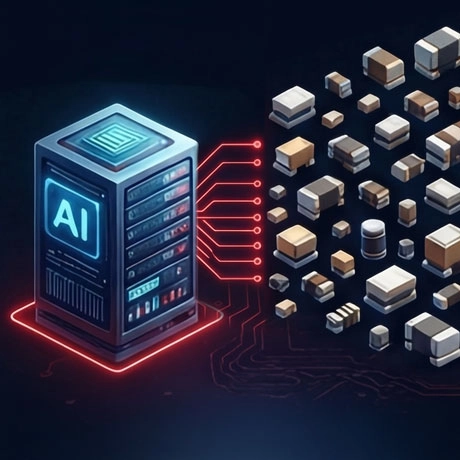

Top Holdings (Aug 24, 2026)
Companies involved in MLCCs, conductive polymer capacitors, aluminum electrolytic capacitors, and polymer hybrid capacitors used in AI servers.
Texas Instruments and Analog IC Shortage
AI servers require significantly more passive components than conventional computing architectures.
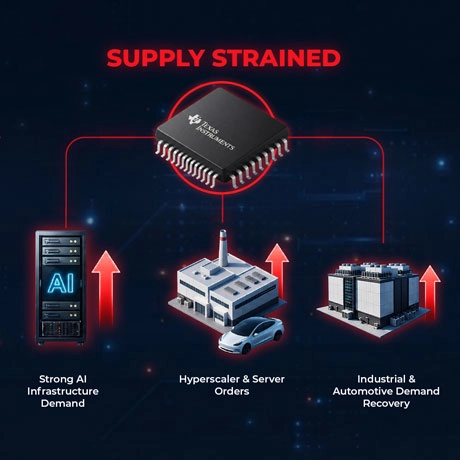
- The Power Architecture Shift: As AI rack power scales toward 1MW, architectures are rapidly transitioning from legacy 12V grids to advanced 48V and high-voltage 800 VDC power distribution systems. Companies like TI have engineered specialized power components, such as 30kW power-supply units and high-density smart power modules, to handle these intense current demands.
- Aggressive Hyperscaler Buying: Hyperscalers and server builders are heavily buying up analog and power management components to fuel AI infrastructure expansion. This surge, combined with strong recovery curves in industrial and automotive sectors, has caused TI's data center revenue to experience explosive multi-fold surges (with some periods registering 70% to 90% year-over-year growth).
- Price Increasing: Recently TI announced upcoming price adjustments that will impact on their products portfolio based on the specific materials, technologies and manufacturing processes involved.
- A Systemic Industry Trend: It is not just TI. Competitors like STM and Analog Devices (ADI) have similarly warned customers of tight supply, with lead times stretching up to six months as industry-wide lead time indexes hover near 26 weeks on average.
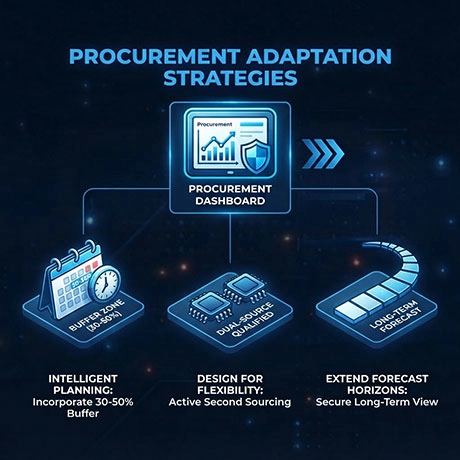
How Procurement Teams Can Adapt
Short-term ordering and legacy procurement strategies are no longer sufficient in an AI-driven semiconductor super-cycle. Hardware designers and supply chain managers must adopt new measures to maintain continuity:
- Plan Ahead: Treat manufacturer-quoted lead times as a baseline floor rather than a guaranteed delivery date, factoring in a 30% to 50% buffer for allocated parts.
- Design for Flexibility: Keep second-source qualifications active early in the design phase to avoid unexpected production halts.
- Extend Forecasting Horizons: Protect your pipeline by securing long-term forecasting horizons and collaborating closely with trusted global distribution channels.
How ASC Global Can Help
Navigating extended lead times and component allocations requires a proactive partner on the ground.

Bypass 26-week Texas Instruments lead times and capacitor shortages with ASC Global. We help customers protect their supply chains by:
- Securing hard-to-find and allocated analog, PMIC, and passive components.
- Performing proactive BOM analyses to identify single points of failure early.
- Managing custom stocking programs tailored to your production schedules.
- Guaranteeing rigorous quality control and component authenticity.
The 2026 semiconductor market is undoubtedly challenging, but it is not unmanageable. It simply requires a new playbook. By embracing proactive planning and leveraging the right global partners, procurement teams can navigate these structural shifts and secure the components they need to thrive.
Looking Toward the Future
Are you ready to adapt your procurement strategy for the new market reality? Contact ASC Global today to learn how our sourcing specialists can help you secure your supply chain.