

Get biweekly updates to your inbox
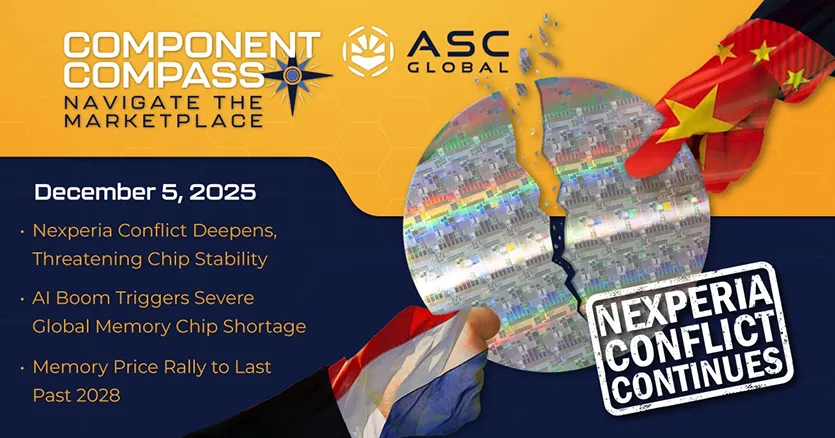
Nexperia Conflict Deepens, Threatening Chip Stability
Tensions between Nexperia’s Dutch HQ and Chinese parent Wingtech have escalated, with each side accusing the other of obstructing operations and disrupting wafer flows. Wingtech claims loss of lawful control, while Dutch leaders deny blocking communication. The governance standoff now threatens global automotive and industrial supply chains reliant on Nexperia’s mature-node components.
Memory Price Rally to Last Past 2028
Samsung and SK hynix, commanding approx. 70% of the DRAM market, are prioritizing profitability over aggressive capacity expansion, fueling expectations that the memory super-cycle could extend past 2028. This conservative approach minimizes oversupply risks amidst soaring AI demand. Both firms are hesitant on long-term supply agreements due to sharply rising prices and intensifying shortages.
AI Boom Triggers Severe Global Memory Chip Shortage
A worldwide shortage of memory chips is intensifying as AI expansion collides with limited supply. Rising demand for HBM, DRAM, and flash memory has pushed prices up more than 100%, forcing tech giants and smartphone makers to compete for shrinking inventories. With chipmakers prioritizing high-end AI memory, supply for PCs, servers, and consumer electronics is tightening. Analysts warn the crunch could delay data-center projects, slow AI productivity gains, and add inflationary pressure through 2027.
NAND Supply Crunch Drives 50–100% Price Surge for Transcend
SanDisk and Samsung have delayed NAND shipments to Transcend, triggering a sudden 50–100% price spike amid extreme supply shortages. Major chipmakers are prioritizing hyperscalers and data-center demand, sharply cutting Transcend’s Q4 allocation. With no new deliveries since October and contract pricing now shifting monthly, Transcend expects soaring NAND costs, longer lead times, and tight supply for at least 3–5 months.
Japan–China Chip Tensions Intensify Amid Photoresist Rumors
Japan reportedly tightened photoresist exports after PM Takaichi’s remarks, raising concerns over China’s chip production, Commercial Times reports. Japan controls 70% of the global photoresist market, and 95% of EUV resists, while China remains heavily import-dependent. Rumored shipment pauses by Shin-Etsu and Tokyo Ohka threaten output, as high-end resists cannot be stockpiled. Beijing is accelerating localization, targeting 40% domestic production by 2026.
Intel Gains Major Momentum in Chip Comeback
Intel attracts Apple, MediaTek, and Google as its 18A node matures faster than expected and EMIB packaging expands capacity. Apple may adopt Intel 18A by 2027, ending TSMC exclusivity, while EMIB’s larger, lower-cost packages drive demand amid AI capacity shortages.
More Component Compass news
Intel Renews Malaysia Push with Fresh Investment
Intel revives its Malaysia expansion with an RM860 million ($208 million) boost to packaging and testing, following CEO Lip-Bu Tan’s meeting with the prime minister. The move puts an earlier delayed project back on track, strengthens Penang’s near-complete advanced packaging hub, and complements Intel’s new outsourced EMIB capacity at Amkor Korea.
Marvell Acquires Celestial to Enter Photonics
Marvell will acquire photonics startup Celestial for $3.25 billion, $1 billion in cash plus 27 million shares, to accelerate its move into all-optical interconnects for next-generation AI data centers. CEO Matt Murphy says the deal creates a “silicon photonics powerhouse.” As multi-rack AI architectures shift toward ultra-low-latency optical fabrics, Marvell aims to capture a new TAM in optical interconnects and strengthen its AI connectivity portfolio. The company expects $10 billion in revenue next fiscal year, with photonics adoption projected to begin in data centers by 2027–2028.

NVIDIA Invests $2B in Synopsys to Accelerate AI-Driven Engineering
NVIDIA has purchased $2 billion in Synopsys shares, deepening a partnership spanning CUDA acceleration, agentic AI, and Omniverse digital twins. The companies aim to speed chip and system design through GPU-accelerated simulation, AI-powered autonomous engineering workflows, and cloud-ready tools. CEOs Jensen Huang and Sassine Ghazi say the collaboration will unify electronics, physics, and AI to transform next-generation intelligent system development across semiconductors, robotics, automotive, aerospace, and more.
Germany Reallocates Semiconductor Funding Amid Intel Delays
Germany redirected €2B in semiconductor funds originally earmarked for Intel’s delayed Magdeburg megafab, launching its first competitive EU Chips Act project call. The move accelerates diverse microelectronics investments—from Dresden mature-node capacity to Munich quantum-sensing—and ensures chip-designated budgets aren’t diverted to non-semiconductor programs.

U.S. Backs xLight’s 2 nm EUV Laser Ambition with $150M
The U.S. will invest up to $150 million in xLight, led by former Intel CEO Pat Gelsinger, to develop next-generation free-electron lasers for chipmaking. Targeting ultrafine 2 nm wavelengths, far beyond ASML’s 13.5 nm EUV, xLight aims to improve wafer-processing efficiency by 30–40% and produce first wafers by 2028. The funding, drawn from CHIPS Act allocations for early-stage tech, could make the government xLight’s largest shareholder. The startup is collaborating with national labs and joins other U.S. players exploring advanced light-source alternatives to ASML for next-generation lithography.

EU Backs Onsemi’s First 8-Inch SiC Fab With €450M Grant
The European Commission approved a €450M grant for Onsemi’s €1.64B integrated SiC power device fab in the Czech Republic—Europe’s first full-value-chain 8-inch SiC facility. Opening in 2027, the vertically integrated plant will support EV and industrial demand, expand 200mm SiC capacity, lower costs, and strengthen Onsemi’s automotive partnerships and next-gen SiC roadmap.
INDUSTRY UPDATES
ASC Global brings you with our Component Compass report the latest semiconductor industry findings to provide valuable guidance for maneuvering market intervals. We excel in supply chain strategies that effectively address market volatility.
If any questions or concerns arise, kindly reach out to your Account Manager or our support team at info@ascglobal.com | +1 954 718 2950.
Component Compass Timeline
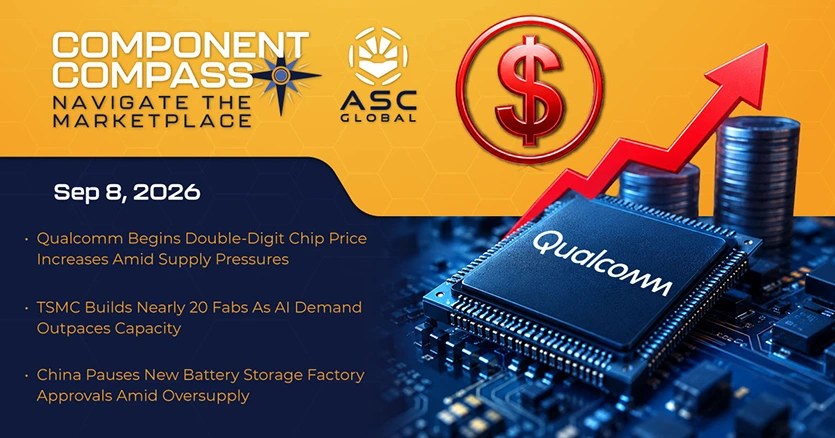
Qualcomm Chip Price Increases Supply Pressures
GlobalWafers Semiconductor Wafer Supply Imbalance
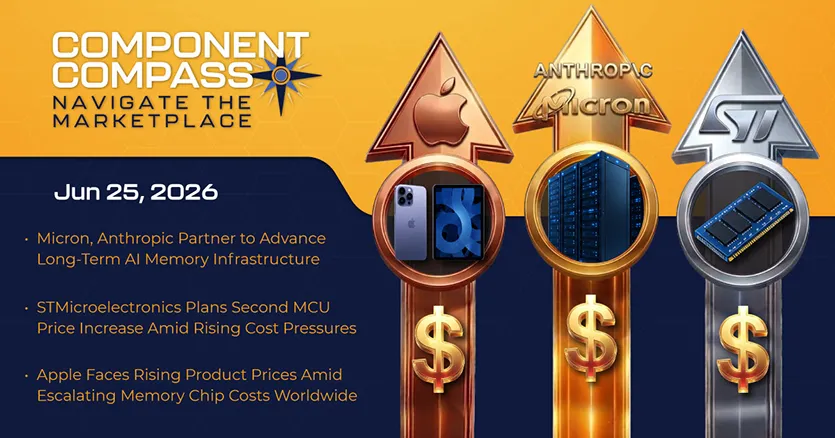
STMicroelectronics MCU Price Hikes, Apple Device Inflation, and Micron–Anthropic AI Memory Supply Shift
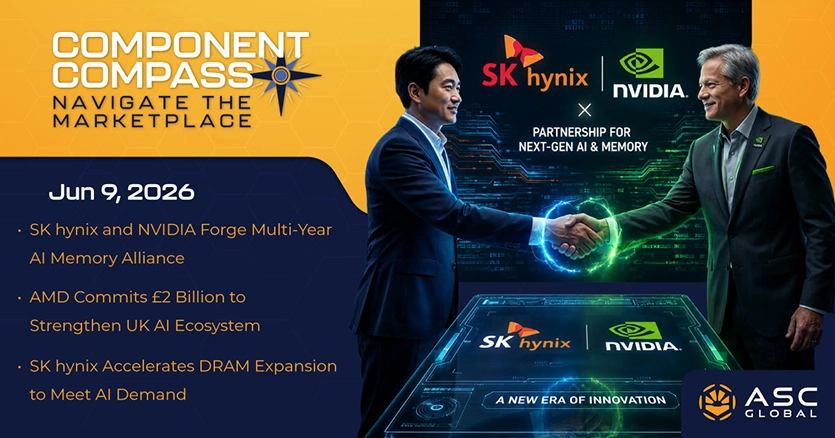
SK hynix and NVIDIA Forge AI Memory Alliance
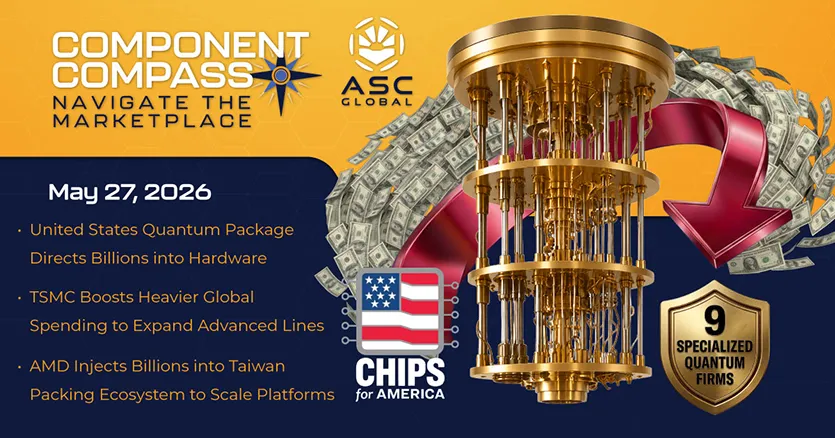
United States Quantum Package Directs Billions
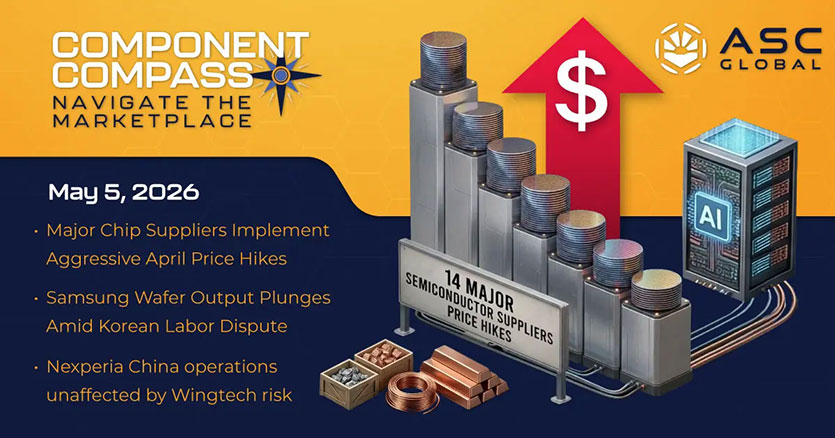
Major Chip Suppliers Implement Aggressive April Price Hikes
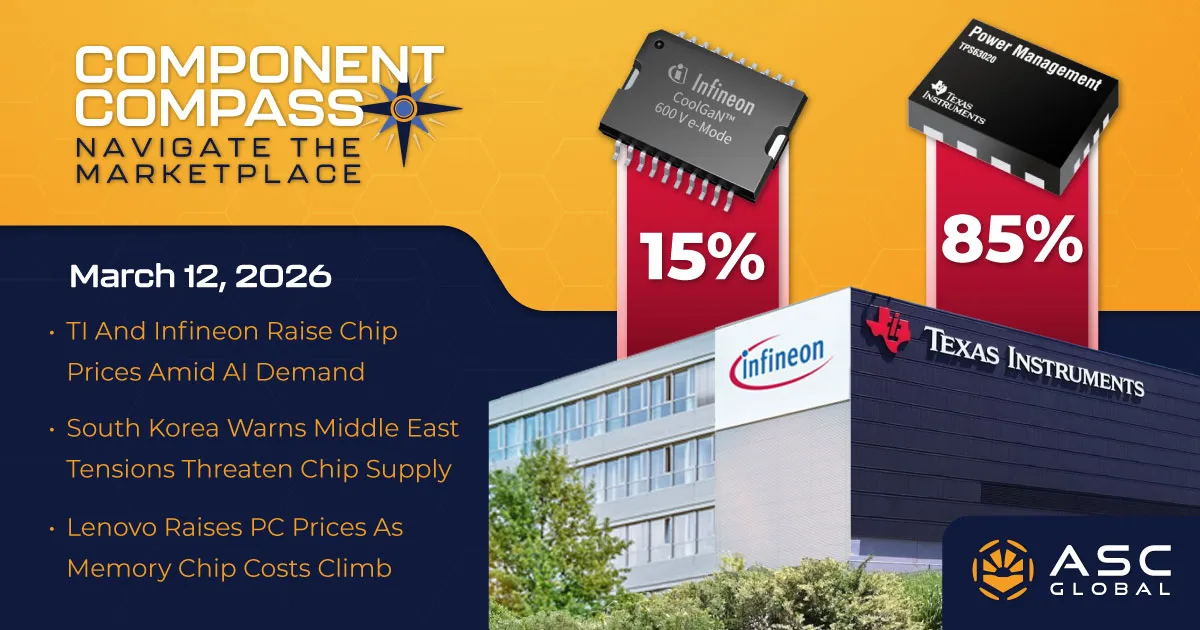
Texas Instruments and Infineon Raise Chip Prices Amid AI Demand
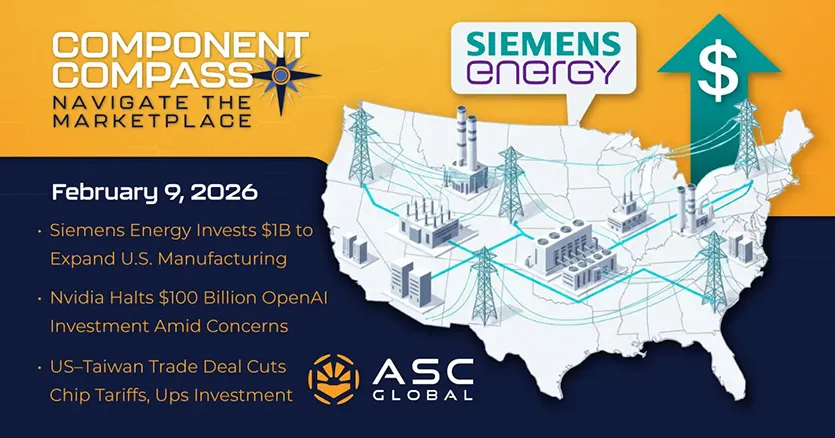
Siemens Energy Invests $1B to Expand U.S. Manufacturing
Nexperia Conflict Deepens Threatening Chip Stability
Market Report