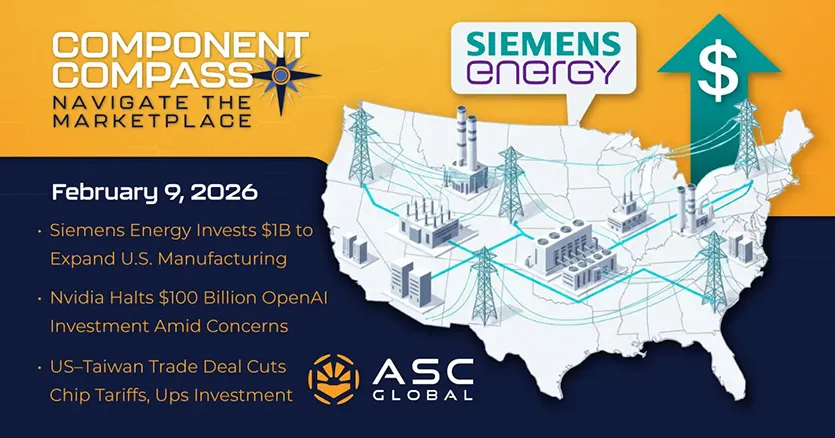

ASC Global's biweekly Component Compass to Navigate the Marketplace

Get biweekly updates to your inbox
First Name(Required)
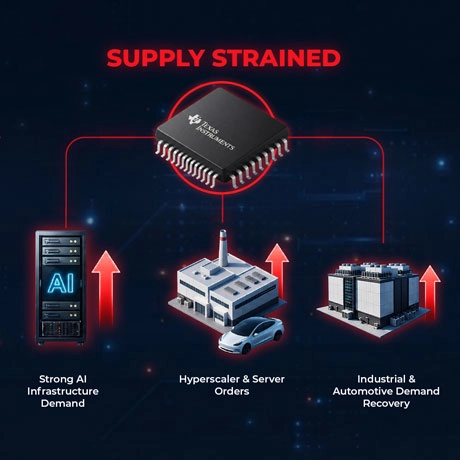
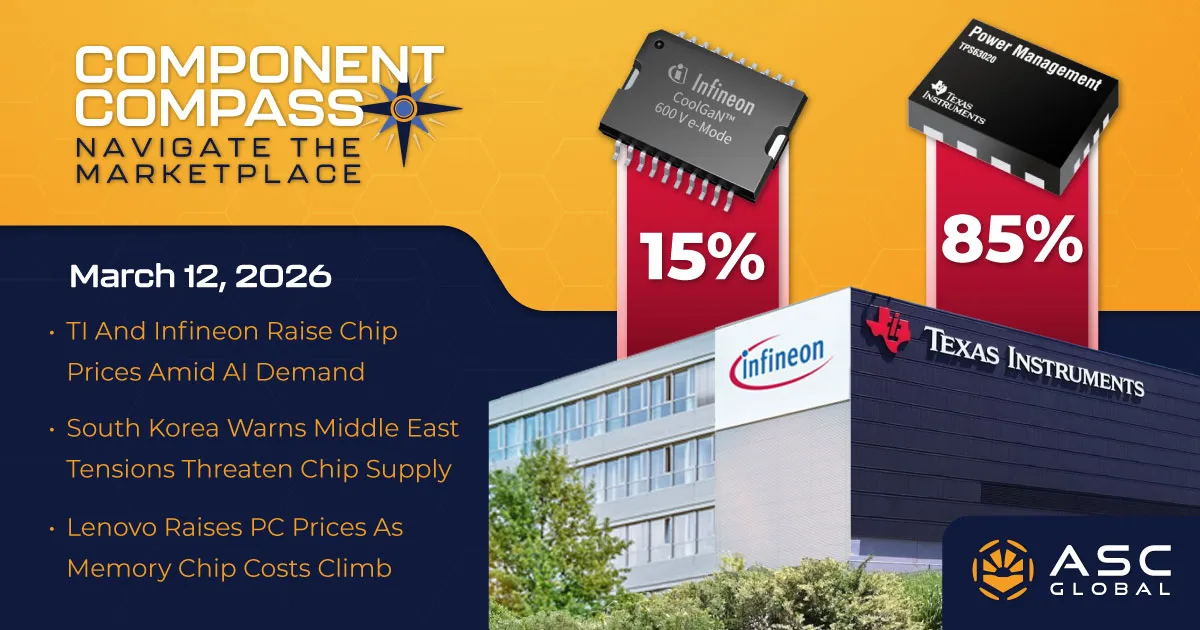
Component Compass banner highlighting semiconductor pricing trends as Texas Instruments and Infineon increase chip prices amid growing AI demand. The image represents power management ICs, digital isolators, industrial electronics, EV technologies, and AI infrastructure, illustrating how rising manufacturing costs and strong demand are influencing component pricing and supply chain strategies across the semiconductor industry

TI And Infineon Raise Chip Prices Amid AI Demand

Texas Instruments will reportedly raise prices up to 85% starting April 1 across products such as digital isolators and power management ICs, affecting both direct customers and distributors. Infineon Technologies plans additional 5–15% increases on power devices. Strong demand from AI servers, EVs, and industrial systems, combined with higher manufacturing and energy costs, is driving the industry-wide adjustments.

South Korea Warns Middle East Tensions Threaten Chip Material Supply

Officials in South Korea warned that escalating Middle East tensions could disrupt supplies of key semiconductor materials. Executives from Samsung Electronics highlighted risks tied to helium, essential for cooling semiconductor equipment and largely sourced from Qatar. Authorities also noted dependencies on other regional materials, raising concerns that prolonged conflict could strain semiconductor supply chains already pressured by growing AI-driven chip demand.

Lenovo Raises PC Prices As Memory Chip Costs Climb

Lenovo has increased prices on several PC models after rising DRAM and NAND memory costs. Distributors report retail prices for some systems are over $145 higher than last year, with adjustments affecting mainly offline retail channels. While student subsidy programs remain largely unchanged, the move reflects growing cost pressure from the recovering memory market impacting PC manufacturers.

Samsung Foundry Sees Groq Orders Rise Amid Tesla Delays

Groq has reportedly increased AI chip orders from Samsung Electronics Foundry from 9,000 to about 15,000 wafers as it moves toward commercial inference chip production. Meanwhile, Tesla has reportedly delayed multi-project wafer production, affecting chips from DeepX and potentially pushing back next-generation NPU manufacturing timelines.

Oracle And OpenAI Cancel Planned Stargate Datacenter Expansion

Oracle and OpenAI have scrapped a planned datacenter expansion in Abilene tied to the $500 billion Stargate AI Infrastructure Program. The decision reportedly followed disagreements over financing and evolving capacity needs. Other Abilene facilities remain under construction, while Meta Platforms is reportedly considering taking over the abandoned site.

More Component Compass news

Illustration of advanced semiconductor wafers being manufactured in a U.S. fabrication facility and transported through a global supply chain to an overseas advanced packaging center. The image represents Apple's plan to produce chips at TSMC's Arizona fab while relying on Taiwan-based packaging technologies, highlighting semiconductor manufacturing, advanced packaging, global chip supply chains, CoWoS technology, and ongoing efforts to expand U.S. semiconductor infrastructure.

Apple’s U.S.-Made Chips Still Depend On Taiwan Packaging

Apple plans to produce over 100 million chips in 2026 at TSMC’s Arizona fab, but the wafers must still be shipped to Taiwan for advanced packaging. Most high-volume technologies such as CoWoS remain concentrated in Asia. New U.S. packaging facilities from Amkor Technology and TSMC are planned but likely won’t scale until around 2028.
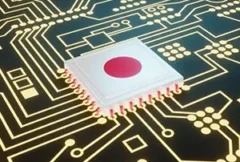
Illustration of a next-generation semiconductor innovation hub featuring advanced chip fabrication plants, AI processors, data centers, and research facilities connected by modern infrastructure. The image represents Japan's strategy to achieve $250 billion in domestic semiconductor output by 2040, highlighting investments in AI chips, semiconductor manufacturing, research and development, data center expansion, and the nation's efforts to strengthen its position in the global semiconductor industry.

Japan Targets $250B Semiconductor Output By 2040 Strategy

Japan aims to reach $250 billion in domestic semiconductor output by 2040 under a strategy led by Prime Minister Sanae Takaichi. The plan prioritizes “physical AI” chips for machine control, targeting 30% global market share. Government support will include R&D centers, industrial land access, infrastructure development, and regulatory changes to attract semiconductor fabs and data center investments.
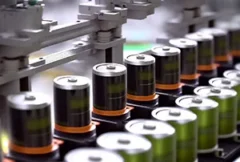
Illustration of an advanced battery manufacturing facility featuring AI-driven automation systems, robotic production lines, battery cells, and digital monitoring dashboards. The image represents Honeywell's Battery Manufacturing Excellence Platform deployment at the Alabama Mobility and Power Center, highlighting intelligent battery production, quality optimization, engineer training, EV battery innovation, energy storage research, and the integration of artificial intelligence into next-generation manufacturing operations.

Honeywell Deploys AI Battery Automation At Alabama Mobility Center

Honeywell has delivered its AI-powered Battery Manufacturing Excellence Platform (Battery MXP) to the Alabama Mobility and Power Center. The system will automate battery-production processes, improve cell yields, and accelerate facility startups. The center will also use the platform to train engineers and support research into EV batteries, charging infrastructure, and energy-storage technologies.

Illustration of a modern cloud data center powered by artificial intelligence, featuring high-performance servers, advanced networking infrastructure, and digital analytics dashboards. The image represents Oracle's stronger-than-expected financial results driven by surging AI cloud demand, highlighting enterprise cloud computing, scalable AI infrastructure, data processing capabilities, and continued investment in next-generation cloud technologies supporting businesses worldwide.

Oracle Beats Revenue Estimates as AI Cloud Demand Surges

Oracle reported quarterly revenue of about $17.19 billion, beating Wall Street estimates of roughly $16.9 billion as strong demand for cloud services tied to AI workloads boosted results. Adjusted earnings also topped expectations, and the company forecast continued growth through 2027. Shares rose in after-hours trading as investors welcomed the performance and expanding AI-driven cloud infrastructure strategy.

Illustration of a nationwide telecommunications network featuring fiber-optic infrastructure, 5G towers, satellite connectivity, and digital data streams linking homes, businesses, and industrial facilities. The image represents AT&T's planned $250 billion investment in U.S. connectivity, highlighting broadband expansion, next-generation wireless networks, cloud computing growth, AI-driven data demand, and the workforce supporting critical communications infrastructure across North America.

AT&T Plans $250 Billion Investment to Expand U.S. Connectivity

AT&T plans to invest more than $250 billion in the United States over the next five years to expand telecom infrastructure. The spending will accelerate fiber broadband, 5G home internet, and satellite connectivity deployments nationwide. The initiative also includes hiring thousands of technicians to build and maintain networks like AI, cloud computing, and connected devices drive rapid growth in data traffic.

Illustration of an advanced silicon carbide power semiconductor integrated into high-voltage industrial power systems, featuring electrical grids, data center infrastructure, and power conversion equipment. The image represents Wolfspeed's commercial 10 kV silicon carbide MOSFET

Wolfspeed Introduces First Commercial 10 kV Silicon Carbide MOSFET

Wolfspeed has introduced the industry’s first commercially available 10 kV silicon carbide (SiC) power MOSFET, extending SiC technology into higher-voltage power electronics. The device targets applications such as grid infrastructure, industrial electrification, and AI data-center power systems. It enables simpler converter architectures, improved power density, and efficiencies approaching 99%. The MOSFET also features sub-10-nanosecond switching speeds and a projected lifetime of about 158,000 years under continuous gate bias conditions.

INDUSTRY UPDATES

ASC Global brings you with our Component Compass report the latest semiconductor industry findings to provide valuable guidance for maneuvering market intervals. We excel in supply chain strategies that effectively address market volatility.

If any questions or concerns arise, kindly reach out to your Account Manager or our support team at info@ascglobal.com | +1 954 718 2950.

Component Compass Timeline
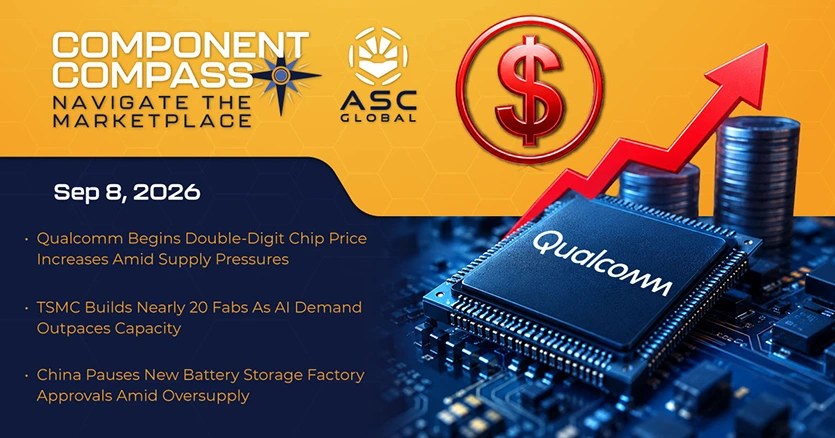
Market Report

Mini banner promoting ASC Global’s Electronics Market Report Q2 2026, highlighting the global memory crisis impacting availability, pricing, and electronics supply chains.

For more news and industry insights dive into our Market Report

Frequently Asked Questions About
Industrial Microsd

How is ASC's industrial-grade MicroSD different from a standard consumer MicroSD card?

The difference starts at the NAND level. ASC's industrial MicroSD line uses true SLC (Single-Level Cell) architecture on capacities from 4GB to 32GB, which stores one bit per cell and supports millions of write cycles, compared to the multi-bit-per-cell TLC or QLC NAND used in consumer cards, which wear out far sooner under continuous write loads. Higher-capacity cards (64GB to 1TB) use TLC or QLC NAND graded for commercial or industrial duty depending on the application. Beyond the NAND, ASC's industrial cards carry a locked bill of materials, so the controller, firmware, and NAND source stay fixed for the life of the design rather than changing without notice, which is common with consumer-grade cards sold through retail channels. Every industrial card also ships with a 36-month manufacturer warranty and passes 100% pre-shipment quality inspection, neither of which apply to consumer retail products.

Our last microSD supplier changed the NAND or controller without notice and broke our qualification. How does ASC prevent that from happening again?

BOM changes are one of the most common ways embedded and industrial programs lose qualification on a memory component, because a consumer-grade supplier can substitute NAND die, controller firmware, or even the flash vendor between production runs without informing the customer. ASC's industrial MicroSD program locks the BOM at the point of qualification, so the NAND, controller, and firmware combination your engineering team tested and approved is the combination you receive on every reorder for the life of the program. Combined with 100% pre-shipment inspection and a 36-month warranty, this gives procurement and engineering teams a documented, stable part number to build a long-term hardware lifecycle around, rather than requalifying every time a reorder arrives.

We need microSD cards that survive automotive or outdoor temperature swings and years of continuous power cycling. What environmental and endurance specs does ASC's industrial MicroSD line meet?

ASC's industrial MicroSD cards are built for a -40°C to +85°C operating range and a stable 2.7V to 3.6V power profile, which covers the temperature extremes typical of outdoor enclosures, vehicle cabins, and unconditioned industrial spaces. Mechanically, the cards are rated for 10,000 insertion and removal cycles and are tested against ESD, drops, moisture, corrosion, torque, and bending, conditions that a consumer card is never validated against. On the endurance side, the SLC NAND used in the 4GB to 32GB range supports millions of write cycles, which matters for applications like continuous data logging, HMI displays, and always-on surveillance recording where the card is written to constantly rather than occasionally. All cards support the SD 6.1 and UHS-I specifications plus SPI interfaces, with read speeds up to 100MB/s and write speeds up to 80MB/s.

Global memory shortages have made microSD allocation and lead times unpredictable. How does ASC keep supply stable for OEM production schedules?

ASC's industrial MicroSD manufacturing runs independently of the open-market NAND allocation swings that have driven the broader memory shortage, with production capacity of up to 1.5 million units per month and flexible scaling for OEM and high-volume programs. First orders ship in approximately 3 weeks, with faster turnaround on repeat replenishment orders, and customers on ASC's program receive priority allocation during industry-wide shortage periods rather than competing for open-market spot inventory. ASC also supports long-term lifecycle planning mapped to multi-year hardware programs, volume pricing tied to forecast-based manufacturing, and global logistics integration, so a production schedule set 12 to 24 months out can be planned against a defined supply commitment rather than quarter-to-quarter market conditions.

We want a private-label or custom-firmware microSD solution for our product line. What does ASC's manufacturing program support?

ASC's industrial MicroSD manufacturing includes OEM and private-label support, with customizable packaging and firmware tailored to the customer's application, in addition to standard catalog cards. Because production runs through ASC's own manufacturing rather than a repackaged consumer supply chain, customers can work directly with ASC's team on firmware behavior, capacity point, and NAND grade (SLC, TLC, or QLC) before the design is locked, and that configuration becomes the fixed BOM for the life of the program. Free samples are available with full engineering evaluation and compatibility testing before committing to a production order, which lets your team validate the custom configuration against your existing hardware and firmware before volume manufacturing begins.

How does ASC verify quality on every microSD shipment before it reaches our production line?

Every industrial MicroSD order goes through 100% pre-shipment quality inspection before it leaves ASC's manufacturing facility, backed by a 36-month manufacturer warranty on the finished product. This sits alongside ASC's broader quality infrastructure across its component lines, including AS 6081:2012 certification for counterfeit avoidance, ISO 9001:2015 and AS 9120:2016 certifications supporting traceability for regulated industries, and an in-house testing lab capable of XRF analysis and electrical testing to confirm that a card's marked capacity, NAND grade, and temperature rating match what actually ships. For programs that need documentation beyond standard inspection, including automotive, medical, or aerospace end uses, ASC can provide certificates of conformance and traceability records covering the manufacturing lot.

Related News

Loading...